


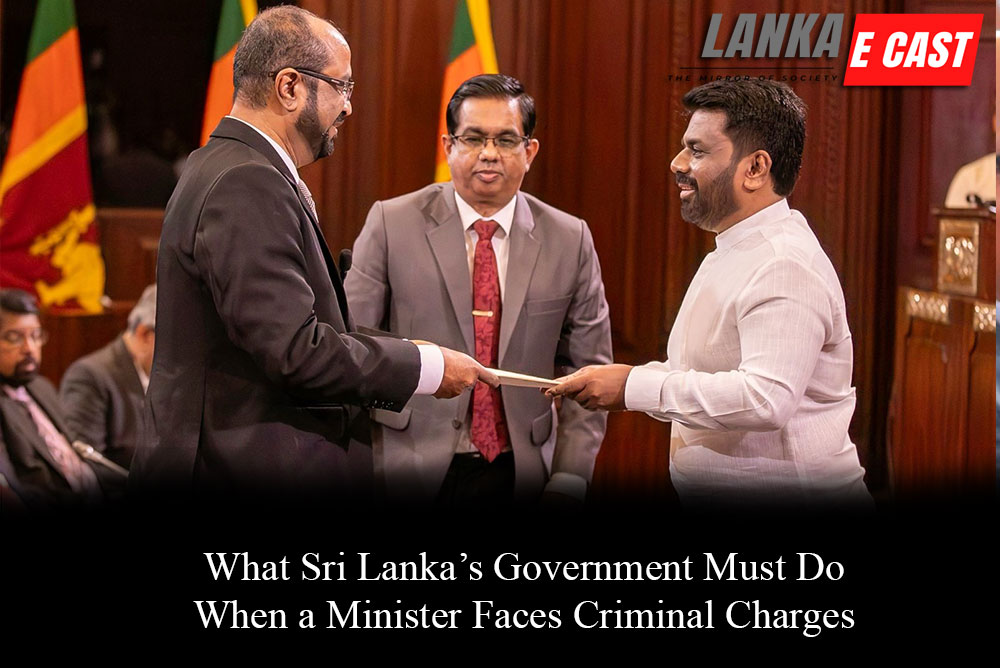
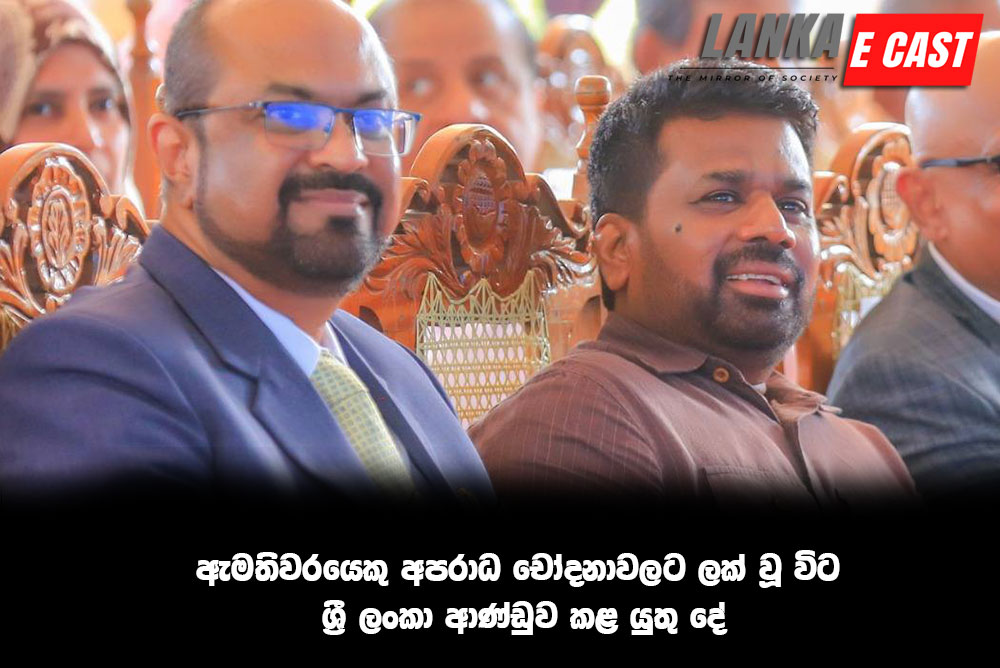
In any democracy, power and accountability are inseparable. When a minister stands charged before a court of law, the government faces a defining moment. It is not merely a legal inconvenience. It is a test of the government’s democratic character.
The principle at stake is simple. Those who exercise public trust must be held to the highest standard of conduct. When that standard is placed in doubt by a criminal charge, the minister must step back. Not as a concession of guilt, but as a recognition that the office is greater than the officeholder.
The Westminster Precedent: Standing Aside is Not Optional
Sri Lanka inherited its parliamentary framework from the Westminster tradition. In the Westminster system — the United Kingdom, Australia, Canada, New Zealand — the answer to a minister being criminally charged is clear. The minister must stand aside from ministerial duties immediately.
“Standing aside” does not mean resignation. The minister may remain a member of parliament. However, he/she must suspend their executive responsibilities. This includes their ministerial salary, access to cabinet documents, and authority over their portfolio.
This is not a punishment. It is a safeguard. It ensures unresolved criminal allegations do not taint the government. It prevents the minister from using the powers of office to influence proceedings that concern them personally.
The responsibility for enforcing this falls squarely on the President, because of the executive presidential system Sri Lanka is continuing with. When a minister is charged, the head of government must act promptly. Delay sends a damaging message: that political loyalty outweighs legal accountability. In Sri Lanka, where public trust is hard-won and easily lost, such a signal would be deeply corrosive.
Does It Matter When the Alleged Offence Occurred?
This is a critical question. What if a minister is charged for something they allegedly did before taking office? Does a different procedure apply?
The short answer is ‘no’. The standing aside requirement applies regardless of when the alleged offence occurred. Whether that act took place last month or ten years before the minister was appointed, the same convention applies. The minister must stand aside.
This is because the issue is not only what the minister did or did not do. The issue is whether the government can credibly uphold the rule of law while allowing an accused person to wield executive power. The timing of the alleged offence does not change that question.
Parliamentary privilege does not protect a minister from arrest or prosecution for actions taken before they entered office. Privilege covers only what is said or done in parliamentary proceedings — debates, votes, committee work. It does not extend to the private conduct of individuals, even if they later become ministers.
In practice, when the alleged conduct predates the ministerial appointment, the President may seek advice from an independent authority or the head of the relevant government department. He may refer the matter for investigation to assess whether the charges constitute a breach of the ministerial code of conduct. However, the outcome of that review does not preclude the requirement for the individual to standing aside from their ministerial duties, till an impartial investigation exonerates them of guilt.
Individual Ministerial Responsibility
At the heart of responsible government lies individual ministerial responsibility. Ministers are accountable to parliament — and through parliament, to the people — for every action and every decision they take in office.
The question becomes whether the government can credibly claim to uphold the rule of law while allowing an accused person to continue wielding executive power. The answer, in any genuine democracy, must be ‘no’.
Sri Lanka’s constitution and ministerial codes of conduct must reflect this principle clearly. A charge in a court of law — particularly for a serious criminal offence — constitutes at minimum a prima facie case. Even before a verdict is reached, the government is entitled — and indeed obliged — to require the minister to step back.
Two Processes Run Simultaneously
When a minister is charged, two separate processes begin at the same time. The first is the criminal justice process. This belongs to the courts alone. It proceeds independently of the government. The minister faces the same legal process as any ordinary citizen.
The second is the political accountability process. This is governed by the ministerial code of conduct. It is faster and does not wait for a verdict. The government acts immediately — requiring the minister to stand aside — to uphold the integrity of the executive.
These two processes are separate from each other. However, they are not unrelated. The outcome of the criminal process directly determines what happens in the political accountability process.
After the Court Decides: Acquittal or Conviction
If the minister is acquitted, the matter is closed. The government may restore the individual to the portfolio. The period of standing aside is treated as a temporary and appropriate measure taken in the public interest — not as a prejudgment of guilt. This affirms the presumption of innocence while demonstrating that the government took the charge seriously.
If the minister is convicted of a serious criminal offence, resignation is not merely expected. It is required. A convicted person cannot credibly hold a position of public trust.
If the minister refuses to resign, the head of government must act. President must advise the relevant constitutional authority to dismiss the minister from office. This is not a matter of political choice. It is a constitutional obligation.
Throughout this process, the government must ensure continuity of public service. The portfolio vacated by the minister does not go unattended. An acting minister is appointed. Government continues. The administration does not stop because one minister faces the courts.
The Government Must Not Interfere
Perhaps the most critical obligation of the Sri Lankan government in such circumstances is what it must not do. It must not interfere with the judicial process.
The executive branch — the President, the Prime Minister, the cabinet — has no role in the proceedings before the court. The government must not seek to influence witnesses. It must not delay prosecutions. It must not use any instrument of government power to protect the accused minister from the legal process. The government of Sri Lanka has so far appeared to have adhered to this principle.
The separation of powers is not an abstract legal theory. It is the practical guarantee that no person — however powerful, however politically connected — stands above the law. When governments in Sri Lanka have historically blurred this line, the consequences the country and its society had, have been grave. It has eroded public confidence. Impunity has grown. Judicial independence has been compromised.
The NPP-JVP government came to power on a platform of anti-corruption and institutional reform. For a government that rose on the promise of a clean break from the past, any sign of protecting its own from legal accountability would be a profound betrayal — not just of the electorate, but of the very principles that animated its rise.
A Test of Democratic Maturity
How a government behaves when one of its own faces criminal charges is the truest test of its democratic commitment. It is easy to speak of accountability in the abstract. It is harder — and far more significant — to act on it when the accused is a colleague, a loyalist, a political ally.
Sri Lanka’s government must rise to this test. It must require the accused minister to stand aside without hesitation. It must ensure the judicial process proceeds freely and without interference. It must appoint an acting minister so that public services continue. And if conviction follows, it must act swiftly to remove that person from office, with or without that person’s cooperation.
None of this is radical. In parliamentary democracies, it is entirely conventional. The challenge for Sri Lanka is to make the conventional real — to transform written principles into lived practice, and in doing so, to build the institutional trust that no government can manufacture through rhetoric alone.
The law must be seen to be applied equally. The office must be seen to be greater than the officeholder. And the government must be seen — not merely said — to believe that no one, including its own ministers, is above accountability. That is what responsible government demands. That is what the people of Sri Lanka deserve.
30 March 2026
Lionel Bopage




Leave a Reply