


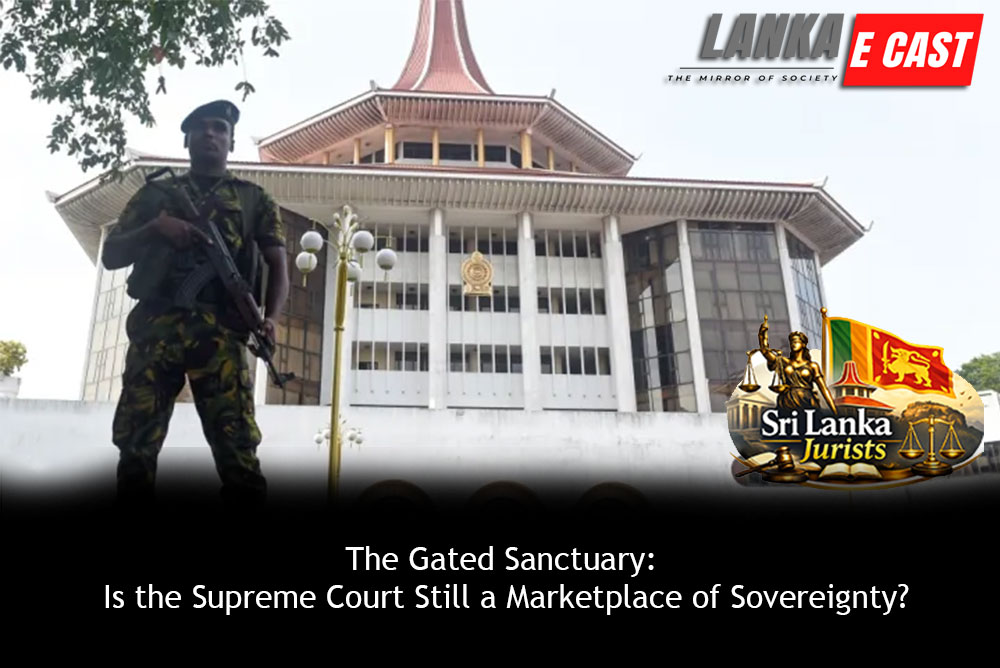
In the classical tradition of jurisprudence, the Court is not merely a government department; it is the Marketplace of Grievances. It is the only forum where the “Sovereign”—the People—can trade their vulnerabilities for the currency of Justice. Yet, a chilling wind has swept through the corridors of Hulftsdorp. A new “jurisprudence of the threshold” has emerged, where the Leave to Appeal (LA) and Fundamental Rights (FR) applications are being met with mass-scale refusals at the gate.
If the Supreme Court continues to treat “Leave” as a weapon of docket-clearing rather than a filter for justice, it risks transforming from a sanctuary of rights into a mausoleum of silenced pleas.
I. The Usurpation of Sovereignty
Under Article 3 of the Sri Lankan Constitution, sovereignty is in the People and is inalienable. When a citizen files an FR application, they are not asking for a favor; they are exercising their sovereignty. By adopting an attitude of mass refusal at the “Leave to Proceed” stage, the Court is effectively staging a quiet coup against the citizen’s right to be heard. Jurisprudentially, “Leave” was intended to weed out the frivolous, not to provide a shortcut for the Court to avoid complex, politically sensitive, or “inconvenient” litigation. To refuse leave without a reasoned order is to tell the Sovereign that their grievances are not worth the Court’s time.
The Threshold of Exclusion: Devaluing the Currency of Justice
In the architecture of our legal system, the Supreme Court is not a court of “error correction” for every minor factual slip in a lower court; it is the architect of the Law itself. This distinction is maintained through the mechanism of Leave to Appeal (LA). However, what was intended as a filter for quality has become a wall of quantity.
I. The Orthodox Definition: What is a “Substantial Question of Law”?
Traditionally, the Supreme Court of Sri Lanka has defined a “substantial question of law” (the primary ground for granting leave) as one that possesses three distinct characteristics:
- Debatability: The question must be “open to argument” and not one that is already settled by a clear line of authority.
- Materiality: It must have a direct and material bearing on the rights of the parties.
- Public Importance: It often transcends the immediate dispute to affect the general development of the law.
In the classical view, if a petitioner presents a point that is fairly arguable and has not been definitively put to rest by a Full Bench, the Court is obligated to grant leave. The purpose is to allow the “sovereign” to ventilate a grievance that the existing law has not yet adequately resolved.
II. The Deviation: The Rise of “Threshold Jurisprudence”
The “mass scale refusal” to grant leave observed recently marks a radical departure from this principle. We are witnessing a shift from Substantive Review to Threshold Rejection.
The Court has deviated in three critical ways:
- The Mini-Trial at the Gate: Instead of asking “Is there an arguable point of law?”, the Court is increasingly asking “Does the petitioner deserve to win?” at the very first hearing. By deciding the ultimate merit of the case during a brief “support” session, the Court denies the parties the right to a full hearing, written submissions, and the rigorous scrutiny that a final appeal deserves.
- The Silence of Refusal: Jurisprudential transparency requires that a “Court of Record” gives reasons. The current trend of issuing one-line orders—”Leave is Refused”—without identifying why a question is not “substantial,” creates a black hole in our legal history. It turns the “Marketplace of Grievances” into a “Black Market of Discretion.”
- The Erosion of the “Fit for Review” Standard: Beyond questions of law, the Court has the power to grant leave if a matter is simply “fit for review”—a safety valve for gross injustice. By ignoring this broader mandate in favor of mass dismissals, the Court is signaling that “administrative efficiency” (clearing the docket) has superseded the “ends of justice.”
IV. The “Appalling Vista” of Judicial Silence
The current trend suggests an “appalling vista” (to use Denning’s famous phrase)—a future where the Supreme Court is no longer the “Sentinel on the Qui Vive” but a mere “Gatekeeper of the Status Quo.”
A Supreme Court that refuses to hear its people is a Court that has lost its way. It forgets that its power does not come from the silk robes or the high bench, but from the trust of the man on the street. When that man is turned away at the door, time and time again, he stops looking to the law for solutions. And that is when the social contract truly unravels.
IThe Denning Warning: The “Appalling Vista” of a Closed Court
Lord Denning’s philosophy was rooted in the idea that the court must be the Sentinel. In Gouriet v Union of Post Office Workers, he reminded us that if the law is to be respected, it must be accessible.
“If the gates of the court are closed to the citizen, the law becomes a dead letter. A judge who refuses to hear a case because it is difficult or numerous is a judge who has forgotten that his power is a trust from the People.” By curtailing new actions through mass refusals, the SL Supreme Court is creating what Denning feared: an “Appalling Vista” where the public loses faith in the legal system as a peaceful resolver of conflict. When the “Marketplace of Grievances” is closed to the sovereign citizens, they do not stop having grievances—they simply stop bringing them to the Court.
Restoring the Social Contract
The Supreme Court must recognize that every time it grants leave, it is not “adding to its workload”—it is validating the sovereignty of the citizen. The current “threshold jurisprudence” is a devaluation of the constitutional currency. To restore the marketplace, the Court must return to the “Bold Spirit” of Denning: it must be willing to open the door, hear the argument, and let justice be seen to be done, rather than strangling the plea at the threshold.
The Jurisprudential Verdict
The “Mass Refusal” of leave is not an administrative efficiency; it is a constitutional withdrawal. The Supreme Court must once again become the “Bold Spirit” that Denning championed. It must reopen the marketplace of grievances and remember that its primary duty is not to finish its calendar, but to dispense justice to the Sovereign from whom its very power is derived.
The Recent Trend: From “Sentinel” to “Gatekeeper”
Historically, the Sri Lankan Supreme Court was seen as the “sentinel on the qui vive” (the watchful guardian). However, the recent attitude adopted in 2024–2026 reflects a troubling “jurisprudence of avoidance.”
- Mass Refusal of FRs: Fundamental Rights are the heart of the Constitution. By refusing leave at the threshold, the Court assumes a “pre-trial” certainty that often ignores the nuanced violations of state power.
- The LA Bottleneck: Leave to Appeal is intended to ensure only cases with a “substantial question of law” proceed. However, when this is used as a tool for “docket clearing,” the Provincial High Courts and the Court of Appeal effectively become the final arbiters, despite the Supreme Court’s constitutional role as the final court of record.
Conclusion
The Supreme Court must remember that every “Refusal to Grant Leave” is not just a procedural order; it is a rejection of a sovereign citizen’s plea. To keep the marketplace of grievances healthy, the Court must return to being “Bold Spirits.” As Denning would argue, it is better for the Court to hear a difficult case and find no merit than to refuse to hear it and leave a potential injustice to fester.
~Sri Lanka Jurists~
follow us on Social Media
https://www.facebook.com/SriLankaJurists
E Mail: srilankajurists@gmail.com











Leave a Reply